
Living with the End in Mind (Part 2)
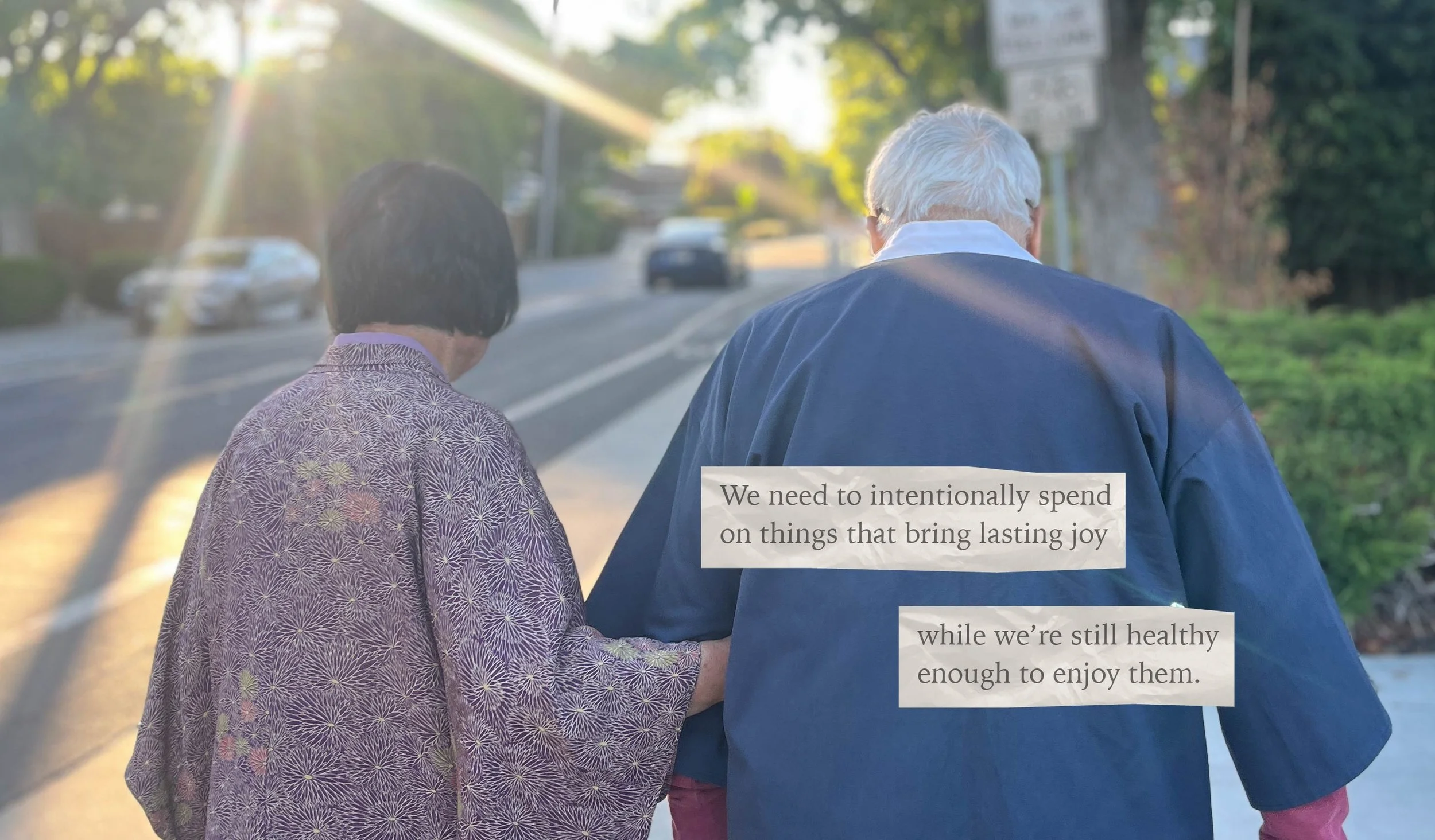
Two seniors take a walk outside arm in arm after attending Obon.
What can we actually do to live our lives fully? Here is a book I’d like to introduce that may answer the question. It’s called “Die with Zero: Getting All You Can from Your Money and Your Life” by Bill Perkins. The book’s core message is simple and provocative: instead of trying to accumulate as much money as possible before we die, we should aim to maximize our life experiences—to use our time, money, and energy to live fully. Perkins argues that many people work hard, save diligently, and look forward to retirement—only to realize, often too late, that they’ve postponed joy for too long. He urges us not to over-save and under-live. He says we need to intentionally spend on things that bring lasting joy—while we’re still healthy enough to enjoy them.
One section struck me deeply. He talks about using life expectancy calculators. While they aren’t perfect, they can give us a general sense of how many years we might have left. And knowing that—even approximately—helps us plan better. He says,
“If you think you’ll live to 150, you might save too much and live too little. You’ll die with more than zero—and that means you’ve wasted time, energy, and joy.”
So, I tried two of those calculators. One is called Longevity Illustrator, which gave me a 100% chance of living to 65, and around 70% chance of reaching 87—the average life expectancy for Japanese women. The other one, called Living to 100, asked even more detailed questions about health, habits, and family history—and told me I might live to 95. The results were different, of course. But they made me pause. If I live to 95, that’s another 45 years. And it made me reflect: How do I want to live those years? – What do I really want to prioritize in my life? Where do I want to live? What kind of work do I want to do? What do I really enjoy, what does it mean to live fully, to me? These questions became more vivid, more real. That’s the power of looking ahead. Even without certainty, a number gives us more clarity. Perkins writes,
“Humans are wired to survive, not to thrive. We avoid the subject of death and act as if it’s never coming.”
But what if we let the thought of death awaken us to life? What if we lived with the mantra he strongly recommends: “Maximize total life enjoyment”?
By now, we might intellectually understand the importance of facing death. And yet—let’s be honest—most of us still hesitate to think about our own. Even after all these reflections, I must be honest, I really don’t want to think about it. Death still feels scary to me and hard to imagine.
In Jodo Shinshu, Amida Buddha made the VOW to receive us as buddhas into the Pure Land where no suffering exists. So, when we die. In this tradition, our death day becomes our birthday in the Pure Land. Therefore, I should not be afraid of dying. But I do not want to go to the Pure Land just yet. In “A Record in Lament of Divergences”, or Tannnsho, a book written by Yuien, a disciple of Shinran Shonin, expressed the same feeling to Shinran Shonin: Yuien told Shinran Shonin,
“Although I say the nembutsu, the feeling of dancing with joy is faint within me, and I have no thought of wanting to go to the Pure Land quickly. How should it be for a person of nembutsu?”
And Shinran Shonin replied,
“I, too, have had this question, and the same thought occurs to you, Yuien-bo!”
He explained that it’s natural. It’s our bonnō—our attachments and blind passion. But it is precisely we who feel this way that Amida Buddha embraces.
Our birth to the Pure Land is settled not because we are pure, but because we are ignorant beings with blind passions. (凡夫) When we face our fear, we are facing ourselves. When we continue to face ourselves, we meet the great compassion and wisdom of the Amida Buddha. That is when we are brought to deep relief, realizing we don’t have to fix our fear, and will be accepted as we are. This deep realization brings us deep gratitude for Amida Buddha, and for our precious life.
Let me close by asking you: If you had seven days left, what would you stop doing? What would you begin? What would you do to live your life fully? You don’t have to answer right now. But may the reflection begin. And when fear arises, may we remember Amida Buddha’s Vow: “Come as you are, let yourself completely rely on the working of Amida. I will liberate you from the suffering.”
Namo Amida Butsu.
Thank you.
Yumiko Eshima