
Living with the End in Mind (Part 1)
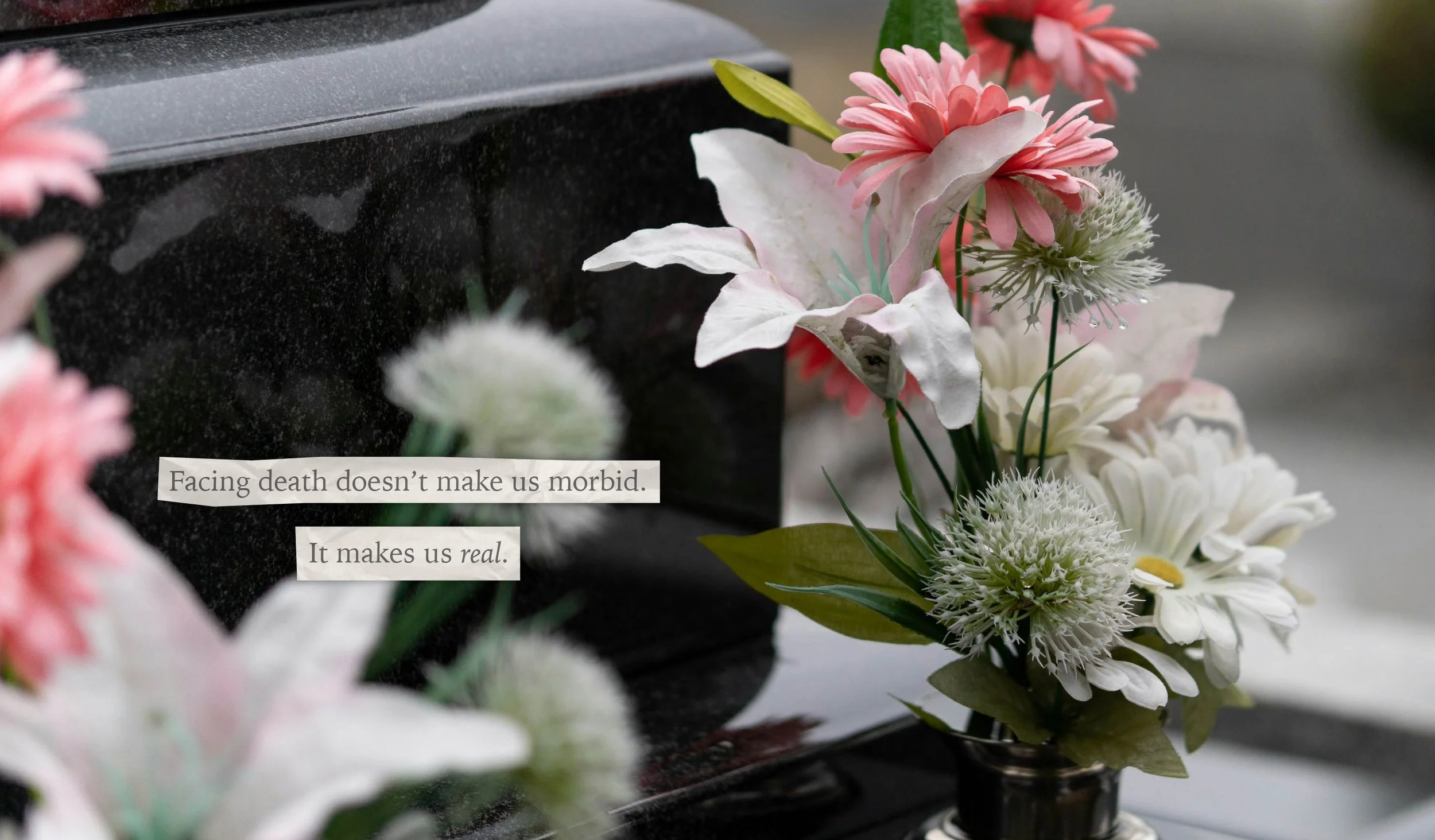
Lilies placed on a grave with the text “Facing death doesn’t make us morbid. It makes us real.”
The theme I want to explore with you is the topic we often avoid — death. But I believe that when we face death with honesty and openness, it can illuminate how we want to live, what we truly value, and what we find meaningful. So today, I invite you into a gentle reflection: What does it mean to live fully, knowing that death is certain? And how can Buddhist teachings—especially in the Jodo Shinshu tradition—support us in facing that truth?
Let me begin with a personal story.
There is only one person whose final moment I have ever witnessed with my own eyes. That person was my grandfather. He was also the one who gently led me toward Buddhism. He set a family rule that every night, we would all gather in front of the onaijin, our home altar, and chant sutras together. Through this, he planted the seed of Buddhism in me.
In Japan, when someone passes away, we have a tradition. There is a wake service お通夜 held the night before the funeral. Then the funeral ceremony takes place the next day, followed by cremation. After the cremation, the family uses special chopsticks to carefully place the bones into a white urn. Finally, the urn is placed into the family grave. I went through this process for the first time in my life when my grandfather passed. I remember looking at my grandfather’s body as he lay in the coffin at home. It was before the funeral, and I felt this deep, hollow ache in my heart—a kind of emptiness I had never known before. At the same time, I found myself thinking, “My grandfather’s body is here… but he’s not here anymore. What does that even mean?” I had no answer. Just the question. That moment stayed with me. And in many ways, it became the beginning of my spiritual path. It was the first time I deeply encountered the end of life.
In Jodo Shinshu Buddhism, there is a famous passage called the White Ashes—Hakkotsu no Sho—written by Rennyo Shonin. It says, “We may have radiant faces in the morning, but by evening we may turn into white ashes.”
This passage was read the funeral of my grandfather and reminds us that death is not far away—it is with us every day. Rennyo Shonin’s words remind us of life’s preciousness. And yet, we live as if we will live forever. I did, even after the passing of my grandfather.
Most of us live our lives avoiding the thought of death. Why? Because it brings fear, anxiety, uncertainty. But here’s the paradox: When we finally do face death—not just intellectually, but with our hearts—we begin to ask deeper questions:
What is truly important to me?
How do I want to spend the time I have left?
Facing death doesn’t make us morbid. It makes us real. It allows us to strip away the superficial and pay attention to what actually matters. When we accept that our time is limited, we stop waiting for “someday.” We begin to live more honestly, more intentionally, and more kindly.
In Japan, this conversation is becoming more open. One example is a growing movement called Shūkatsu —Shu means “the end,” and Katsu means “activities,” so it translates “activities for end-of-life preparation.” Or “end-of life planning.” Shūkatsu encourages people to take charge of how they want to live their final days—by preparing their will, funeral, medical preferences, and so on. The term became widely known after journalist Tetsuo Kaneko made detailed preparations for his own funeral before he passed away. In 2009, the word “Shūkatsu” appeared in a magazine and took root in public awareness.
Now, there are even comic books and TV dramas about end-of-life planning. One drama currently airing on NHK is called “I Want to Die Alone” (Hitoride Shinitai). It follows a 39-year-old single woman Narumi, who enjoys living alone, until her aunt dies a lonely death. This makes her start reflecting on her own future. The show explores how Narumi, despite being independent, begins to feel uncertain. She starts to plan her end-of-life care, not only for herself but also to spare her loved ones confusion or burden. The drama gently shows how facing death can lead to a deeper appreciation of life.
In Tokyo’s Shibuya district, there’s an annual Death Festival. This year, it happened in April for 6 days and 4200 people participated. Buddhist priests (including two Shin Buddhist Priests), Doctors, Artists, spiritual leaders, drag queens, Entrepreneurs, and so on gave lectures, workshops, talks, to explore death without taboo. They call it: “A festival to rediscover death and rethink how to live well.”
Also, in Tokyo, there’s even a Shūkatsu Snack Bar — a cozy bar where people come to talk about aging and dying. Their website says, “We want to talk openly about the future, including old age and death. By thinking about death, we want to reflect on the meaning of life and how we live it.” They even offer a coffin-laying experience, so people can reflect on life from inside a coffin! They say, “there is no Karaoke, but Kannoke (Coffin).”
All of these movements share one message: Facing death helps us live more deeply. And I believe it’s a message we can all benefit from—regardless of where we live or what we believe.
Another powerful reflection comes from hospice nurse Bronnie Ware, who cared for people in their final weeks. She asked them what they regretted most. Here are the top five regrets:
“I wish I had lived a life true to myself, not the life others expected of me.”
“I wish I hadn’t worked so hard.”
“I wish I had expressed my feelings.”
“I wish I had stayed in touch with friends.”
“I wish I had let myself be happier.”
These are not just regrets. They are reminders. They invite us to choose consciously, to live with courage, and to make space for joy, connection, and purpose.