Meditation for the Body, Mind, & Shin Buddhist
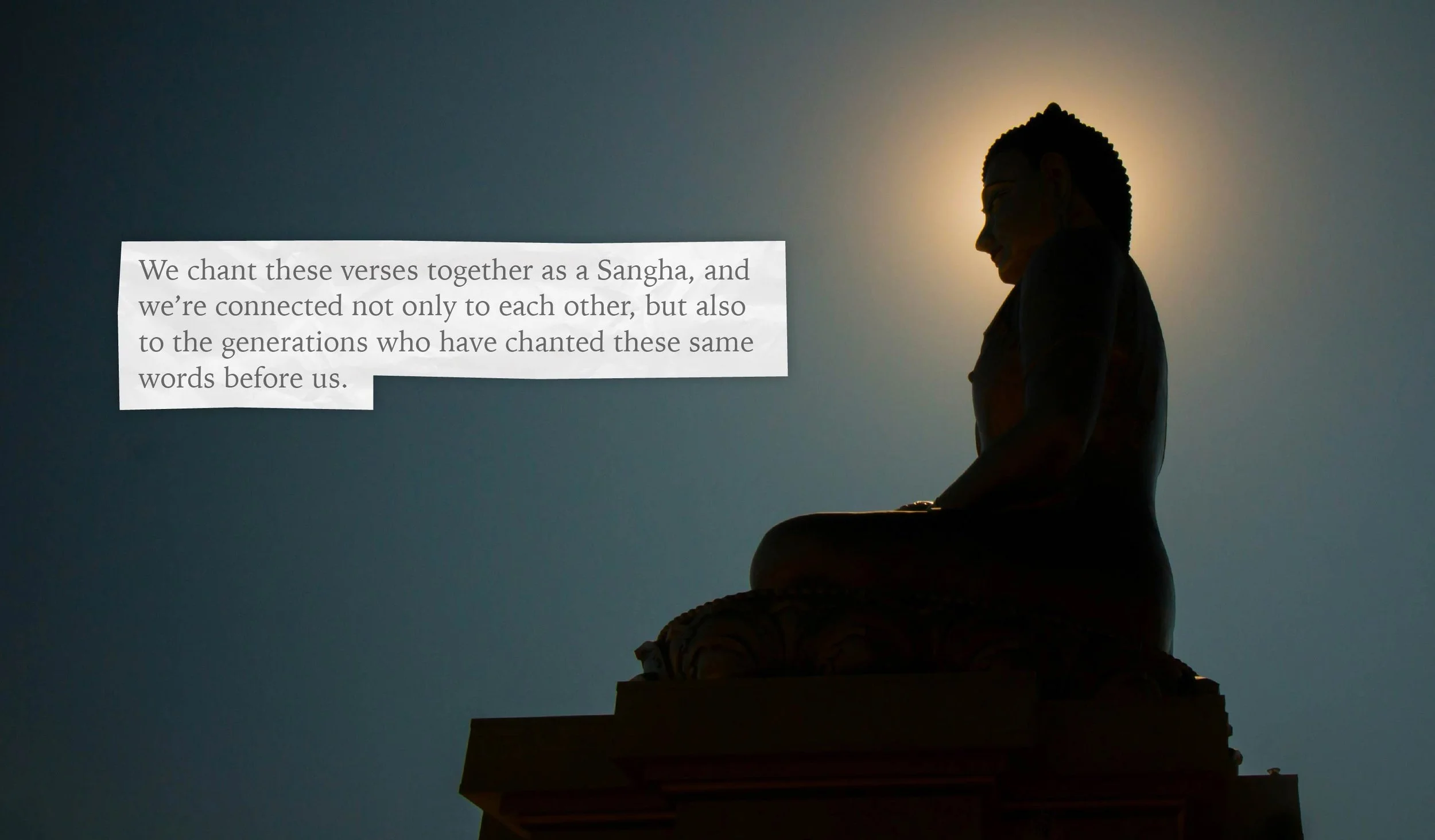
A statue of Buddha with text that says “We chant these verses together as a Sangha, and we’re connected not only to each other, but also to the generations who have chanted these same words before us.”
Most schools of Buddhism have some form of meditative practice. This may include silent meditation. In other schools, it may involve movement, such as walking meditation. Meditation can also be practiced through sound, using bells, mantras, or chanting. It can even be visual, either in the mind’s eye or by focusing on an object such as a flower or a candle flame. There are many ways meditation can be incorporated into Buddhist practice. Even schools where meditation is central, such as in Theravada Buddhism, often include sound or movement as part of its practice. Meditation in the Shin tradition is by sound. The Shin tradition is open to everyone, meaning the practice is accessible to all. Not everyone has the time or capacity for meditation, but most can chant and say the Nembutsu. Sitting meditation can also be a part of our practice, but first, let’s talk about the main meditative practice of Shin Buddhism.
In Shin Buddhism, chanting is one way we fulfill the last two elements of the Eightfold Path which are Right Mindfulness and Right Meditation. Mindfulness is accepting every thing and every experience as it is without judgement. Though meditation involves being single-minded and focused, this is a very immersive practice. When we chant, we feel the sound in our body. We must focus on each syllable of the chant creating that single-minded attention and focus. It also allows us to connect to the ocean of oneness. We chant these verses together as a Sangha, and we’re connected not only to each other, but also to the generations who have chanted these same words before us. While the Nembutsu (Namo Amida Butsu) is not considered a mantra, it works in a similar way. It is a vocal expression of the practice – a sound – that is felt throughout the body affecting both the speaker and audience hearing it. Like with mantras, the meaning of Namo Amida Butsu cannot be accurately summarized in a simple phrase. There is a great deal more depth that goes into the meaning, understanding, and practice of the Nembutsu that we won’t focus on in this post. Rather, we want to highlight one more key practice of Shin which is listening and how sitting meditation can be beneficial.
Listening is a vital part of our tradition. We listen to the Dharma beyond just hearing it. We listen deeply, allowing it to perfume our minds, change our thinking, and influence the way we see and interact with the world. This deep listening is at the core of our practice and where insight usually happens. Being in a meditative state before a Dharma talk can help us with the concentration and focus needed for this type of deep listening. You’ll notice we always chant before the Dharma talk. When we listen to the Dharma, we often gain insight and awareness. It’s the awareness that aids in giving meaning to the Nembutsu. Meditating after a Dharma talk gives a space to reflect deeply on what we have heard.
Through our foundational practices of chanting, the Nembutsu, and deep listening, we can become more open to what is happening in us and around us. We learn to accept things as they are without judgement or attachment. We begin to accept ourselves too – our faults especially. We begin to understand the importance of our faults and discover they are a significant part of our path. It is through our faults that we grow spiritual – not in spite of them. The goal is not to get rid of our faults, but to embrace them, love them, and see them in a different light. Though seated meditation isn’t necessary for the Shin path and isn’t a replacement for main practice, it can support us in our spiritual journey.

A woman practicing yoga on a green yoga mat.
Buddhist meditation often differs from the western form of meditation. When yoga came to the United States, most of the spiritual side of the practice was lost. Core strengthening, flexibility, and other physical benefits became the focus along with mental wellness. Similarly, when meditation came to the west, it was touted as a mental wellness exercise. We often hear about the physical health benefits of meditation. However, with both yoga and meditation, little is mentioned about the spiritual side, so the practice became very flat, losing much of the vibrancy and depth from their origins. That’s not to say the western practices are not valuable, because they are, but rather the modern practice is not designed for the spiritual growth and nourishment we are seeking in Buddhist meditation. For the Buddhist practice of meditation, we can look at three main elements - mind, body, and spiritual.
We need to connect with the body. The mind will follow the body, so when we still the body, we still the mind. Given the nature of our busy lives, we are often disconnected with our bodies. Starting meditation with a body scan allows us to connect more with the body, but it also gives a way to settle in and focus on the task at hand. Moving from body part to body part can be a little more interesting than just the breath, especially if you’re prone to monkey mind. In other words, a body scan can be more entertaining to the monkey. Once we’ve given attention to the body, we can let it go and turn to the mind.
How we’re feeling emotionally can shape our meditation. Many think the goal of meditation is to let everything go and empty the mind. That would be a lovely treat, but the mind doesn’t work that way. If we’re feeling angry, worried, or stressed, we want to give those feelings attention. These strong feelings will continue to flow in and out of our meditation, begging for attention. We won’t be able to let them go until we let them in. By giving the feelings attention, we notice they quiet down as if they just needed to be heard or felt. Often with strong emotions, we observe how they manifest in physical sensations. For example, we might feel frustration in the tightness of our jaw. By paying attention to the tightness, we usually see a change. The tightness will fade, allowing us to build awareness, acceptance, compassion, and openness. By completing a body scan first, we might notice our emotions have naturally settled too. Remember, the mind follows the body. Now that we have addressed the mind-body needs, we can delve into the spiritual side of the practice.

Woman meditating on a dock.
Samatha, or calm-abiding meditation, can be a wonderful complement to the Shin practice as well as mindfulness. Unlike insight meditation (Vipassana), which aims to investigate the nature of experience, samatha is concerned with cultivating stillness and concentration — qualities that support the deep listening at the heart of our tradition. Mindfulness is the practice of bringing our daily lives into meditation without judgement or getting caught up in our thoughts. It’s a gentle acceptance of our experiences. In samatha practice, the meditator focuses on a single object of attention, most commonly the breath, allowing the mind to settle naturally around it. When thoughts arise — and they will — the practice is simply to notice them without judgment and gently return to the breath. This is not about striving or forcing. In its own way, it is a kind of surrender — much like the surrender at the heart of Other Power in Shin Buddhism practice. Similarly, with mindfulness, we are not giving into thoughts and judgements but rather witnessing, accepting, and allowing them to exist. In both forms, we are not trying to manufacture a particular state. We are creating the conditions for stillness, acceptance, and then trusting what arises. Over time, this quality of calm attention and acceptance can deepen our capacity to receive the Dharma, making meditation a quiet but meaningful companion to chanting, the Nembutsu, and deep listening.
Shin Buddhism has always understood that people come to practice through many different doors. Not everyone will be drawn to seated meditation and that is perfectly fine. The path is already whole without it. But if you find yourself curious, or if you've struggled to feel settled before a Dharma talk or during personal reflection, we hope you'll consider exploring these practices gently and without pressure. Begin with a simple body scan. Let the breath follow. Allow whatever emotions are present to be heard and accepted. And then, from that place of quiet openness, let the Dharma in. You may find that stillness and sound, silence and Nembutsu, support each other in ways you didn't expect. The invitation is simply there, whenever you're ready.