
The “Mother” of Jodo Shinshu - Lady Eshinni
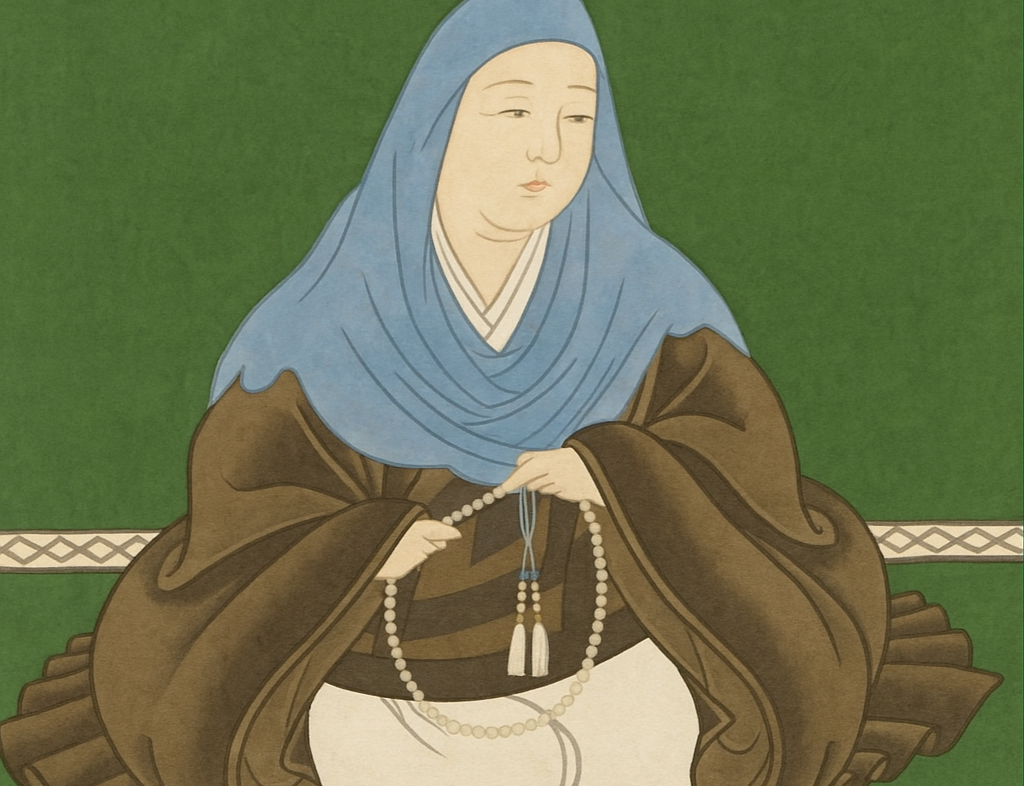
a portrait of Lady Eshinni with a green background
In the history of Jodo Shinshu, we often uplift the names of great male teachers, recognizing their contributions and expressing appreciation. Yet there are other figures who were equally profound contributors, and whose stories too often go untold because of their gender. Among them is Lady Eshinni, not only the wife of Shinran but a vital force in the survival and transmission of the Nembutsu teaching. Her strength, insight, and devotion helped ensure the Dharma could reach future generations.
Lady Eshinni was born around 1182 into a well-off samurai family in Echigo (now Niigata). There, she met Shinran, married and started a family. Her financial position and status as a landowner were major factors in Shinran being able to spread the Buddha Dharma. Had they not met, Shinran may not have survived such tumultuous times when disease and famine were prevalent. The financial stability and support Eshinni provided plays a huge role in our ability to hear the teachings today.
It’s worth noting that Japan’s Kamakura period was different from later periods—particularly in terms of women’s rights. When Eshinni grew up, women in Japan had better rights than most women in Europe. Depending on status, women could own, inherit and sell land, and even become warriors. Many surviving portraits of Eshinni are in the vestments of an ordained woman; however, she still tended responsibilities as a landowner. Evidence shows no conflict between these two roles. As someone who inherited land and money, Eshinni would have had expectations and responsibilities similar to her male counterparts; she would have been far more equal to her husband than people may expect for a woman living so long ago. In fact, rather than the sharing of the Buddha Dharma lying solely with Shinran and his male disciples, Eshinni shared in the duties of running the temple—a tradition that can still be seen in many temples today.
Much of what we know of Jodo Shinshu today has been reinforced through Lady Eshinni’s letters to her daughter, discovered in 1921. Eshinni’s letters give us a better look at their relationship and greater insight into Shinran’s views. In Letters of the Nun Eshinni, James C. Dobbins notes of the 5th letter of Eshinni:
“He [Shinran] discerned how deeply ingrained people’s inclination is to control their own religious destiny and to assert themselves in an endless procession of religious acts, and yet how futile such efforts are. Religious fulfillment, he concluded, lies not in people’s strivings but in faith alone, awakened in them by Amida’s Nembutsu. Eshinni recorded this because, unassuming though the event may have been, his realization made a strong impression on her. It reflects well the process of personal introspection and awakening emphasized in modern Shin Buddhist thought.”
This passage showcases an important point. Eshinni was not merely a submissive wife; she was a person of great insight and religious thought. She recognized the wisdom of an otherwise ordinary moment, and without her recognition of the significance, this information would have been lost to time. Eshinni offers similar insights in her other letters, providing further evidence for Jodo Shinshu scholars and lay followers alike. She devoted herself to the teachings and through that devotion contributed not only financial assistance but academically.
While we are often reminded of the many important patriarchs that helped us find the Jodo Shinshu path we follow today, we don’t often speak of matriarchs. That does not mean that they do not exist; their contributions should also be mentioned often and with gratitude. One such matriarch is Eshinni, who was not only the wife of Shinran but also an ordained priest. Eshinni was not merely a side character in someone else’s story, but an important person in her own right. Without the efforts of Lady Eshinni and her daughter Kakushinni, Shinran and his teachings may not have survived.
Eshinni’s legacy continues today. From ordained ministers and ministers assistants to lay people, women play a crucial part in not only the survival but the thriving of Jodo Shinshu. Take our own temple for example, there are numerous women in multiple groups, the BEC, BWA and the Taiko group who support our Sangha inside and out. The work contributed by these women is not merely a supporting role, in many ways their work is the very backbone that allows us to stand. By including and appreciating the women of Jodo Shinshu, past and present, I believe we grow stronger as a Sangha. Together we walk not just in the legacy of Shinran but in that of Lady Eshinni as well.