The Practice of Not Trying
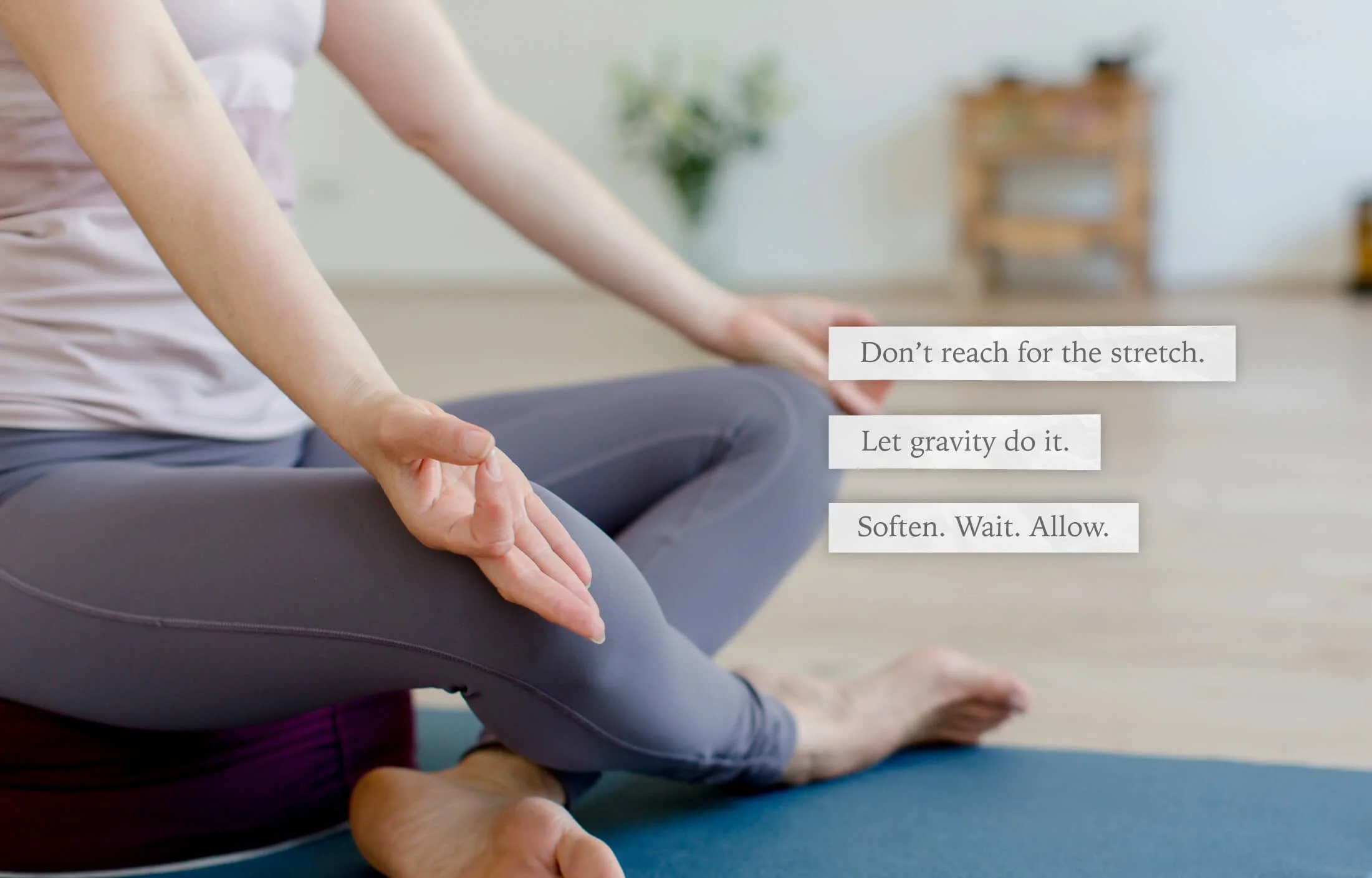
A woman in a yoga pose with the text “Don’t reach for the stretch. Let gravity do it. Soften. Wait. Allow.”
I took a yoga class back in my twenties and walked away angry. Downward dog was hard and did nothing to cultivate the meditative state I thought yoga was supposed to bring. I swore off yoga after that — until someone came to my temple. He was a yoga instructor, and he somehow talked me into taking another class. This one was yin yoga. I didn't even realize there were different types of yoga. But as soon as we got into the swing of things, something about it felt instantly familiar.
For those who may not be familiar with yoga, yin poses are held for minutes at a time, not seconds. And the instructor kept saying the same thing: don't reach for the stretch. Let gravity do it. Soften. Wait. Allow.
The instructions landed like something I already knew, just spoken in a different language. Yin isn't a muscular practice. You find an edge, you stop, and then you get out of your own way. The depth comes from releasing effort, not adding it. Muscles that are actively working can't lengthen. It's only when they let go that gravity is free to do what tension was blocking.
Learning to meditate came with similar directions. You can't force your mind to be still, because forcing creates tension and frustration — the opposite of what you're trying to do. Instead, we're taught to rest our attention gently on the breath or on sounds. Let thoughts pass by like clouds in the sky. And when your mind wanders, gently bring it back without judgement. The rest takes care of itself. But that's not intuitive for many of us.
We tend to picture spiritual practice as effort. Try harder. Meditate longer. Be a better person through sheer willpower. And plenty of paths do work that way, at least at first. But there's another current running through Buddhist teaching, and it points the opposite direction. Not because effort is bad, but because some things can't be reached by force.
This is where the imagery of Amida Buddha becomes useful — as long as we don't get stuck on Amida as a being "out there," granting favors to people who ask nicely enough. Read that way, Amida becomes just another boss to impress, another standard to strive toward. That misses the point of receiving as badly as forcing misses the point of a stretch.

Rather, we might say Amida is a name for reality's own tendency to hold us, exactly as we are, without a performance review. It's less "a figure reaching down to save you" and more "the ground that was always there, once you stop bracing against it." The bracing was never protecting you from falling. It was just tiring you out. Striving assumes you're the one who has to close the distance. Receiving assumes the distance was never as real as it felt.
That doesn't mean doing nothing. Yin yoga still requires you to walk into the room, find your shape, and stay in it — the work is showing up. That's the doing part. What it doesn't require is forcing the outcome. The pose deepens on its own timeline, once you stop interfering.
Maybe that's the invitation here too. Show up. Listen to the Dharma. Stop bracing. See what was already holding you before you started trying so hard to be held.
You don't have to earn gravity. It's already working.