
Who is Saying the Nembutsu?
Middle Voice and Interdependence
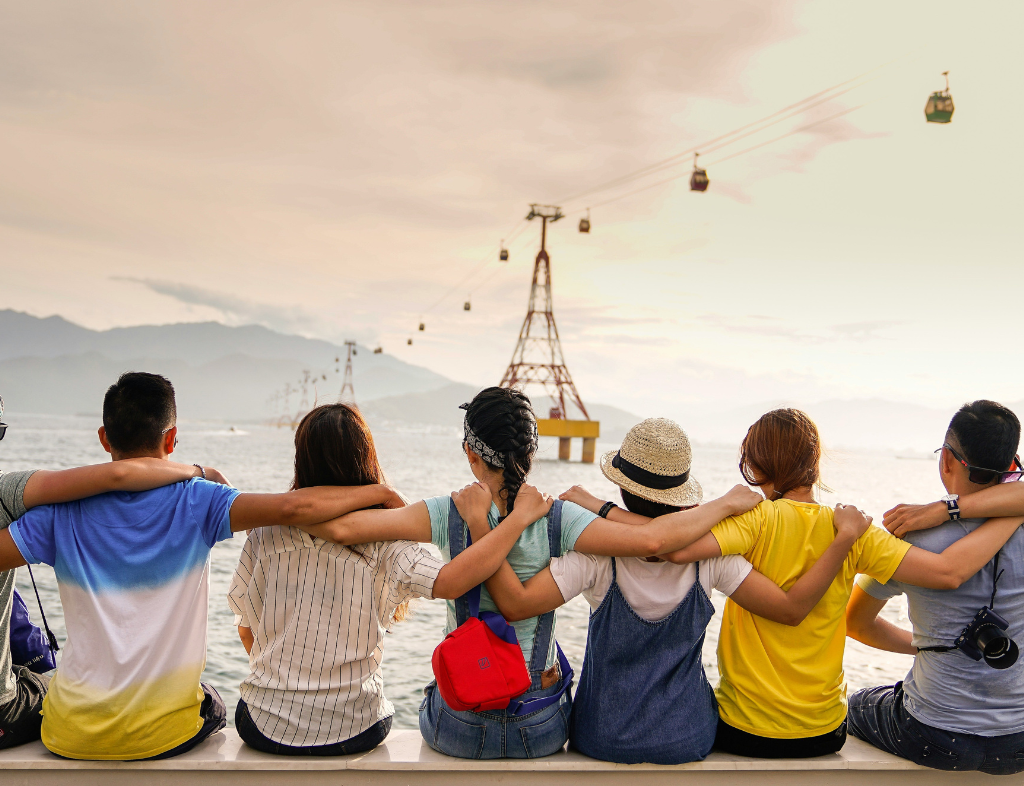
Group of friends sitting side by side on a waterfront railing, arms wrapped around each other’s shoulders in a gesture of unity and camaraderie.
I would like to share with you a little discovery that helped me connect pieces of the puzzle in my spiritual understanding of the Nembutsu. First, I’d like to speak a little bit about my background.
I was born and raised in a Jodo Shinshu temple in Japan. But back then, I had no interest in Buddhism. To me, it felt like something old, boring, and definitely not cool. My grandfather made us chant sutras, mainly Juseige, and Sanbutsuge, every evening as a family. During memorial services, I was forced to clean the hondo, help my mother serve tea, and listen to Dharma. Honestly, it all felt like a burden. I didn’t really appreciate any of it at the time. But life moved on. I left Japan and now live in the U.S.
Over the years, I started to struggle with harsh self-judgment, a lack of confidence, and so on, and found myself not very happy even though I had everything – my job, beautiful kids, and a wonderful husband. Something was missing in my life. So, I turned to psychology and life coaching, and eventually, I found myself coming back to the teachings of Jodo Shinshu.
When I reflect on this journey, I wonder, "how did I end up here, writing this post about Buddhism in the US?" Yes, I did make my own choices in my life, but not everything was under my control. There were many causes and conditions. The fact that I was born into a temple family, the evening routine of chanting set by my grandfather, the people I met, etc... In Buddhism, this is called Interdependence — it means everything arises through countless numbers of causes and conditions.
Nothing stands alone.
This awareness helped me begin to see myself and my life in a new way. Since 2023, I have been attending a study group in Japanese hosted by Rev. Wondra. And in every class, one question kept coming up: Who is saying the Nembutsu? How does Namo Amida Butsu come out of my mouth?
I learned in the study group that true Nembutsu is not something I simply decide to say. When the heart of entrusting Amida Buddha—or Shinjin—arises, gratitude naturally wells up. And from that deep gratitude, the words Namo Amida Butsu are spoken. It may come from my mouth, but that doesn't mean I am the one who decides to say it. That was very hard for me to grasp. Then, recently, I came across the idea of the middle voice.
In English, we mostly know two grammatical voices:
Active voice – “I do something.”
Passive voice – “something is done to me.”
There’s a third option: the middle voice. The idea of the middle voice helped me understand more deeply what it means to say the Nembutsu through the working of Amida Buddha’s Vow. Middle voice describes actions where:
It’s unclear whether the person has full intention or not.
The person is involved, but not fully in control.
The action itself brings about change in the person.
This really helped me see True Nembutsu in a new way. I’m not sure whether I truly intend to say the Nembutsu or not. I’m clearly involved in saying it, but I don’t feel I’m fully controlling it. And the act of saying Namo Amida Butsu has the power to transform me. So, saying Namo Amida Butsu is not just me “doing” something. It is something that moves through me, something that is happening with me, to me, and as me.
Even now, writing this blog post, I don’t feel that I’m doing this alone. There are countless causes and conditions that brought me to this moment. And when I feel that, my heart fills with wow-ness, because I feel connected to the forks who drove on the other side of the road this morning (so that I am alive now), to my grandfather, my ancestors, to Shinran Shonin, and to Amida Buddha.
Thank you very much,
Yumiko Eshima (Esshie)