
The Easy Path Isn't What You Think (Part 2)
When we entrust ourselves to the Primal Vow, “it is a moment of great faith – faith that is tantamount to wisdom.” For Pure Land teacher Shinran, this was the central and defining experience of the spiritual life. Faith was the act of entrusting oneself to Dharmakara’s [Amida’s] vows in the belief that they have made it possible for ordinary people to reach the stage of irreversibility through faith alone.[1]
We often refer to this as the easy path. What makes the path of faith easy?
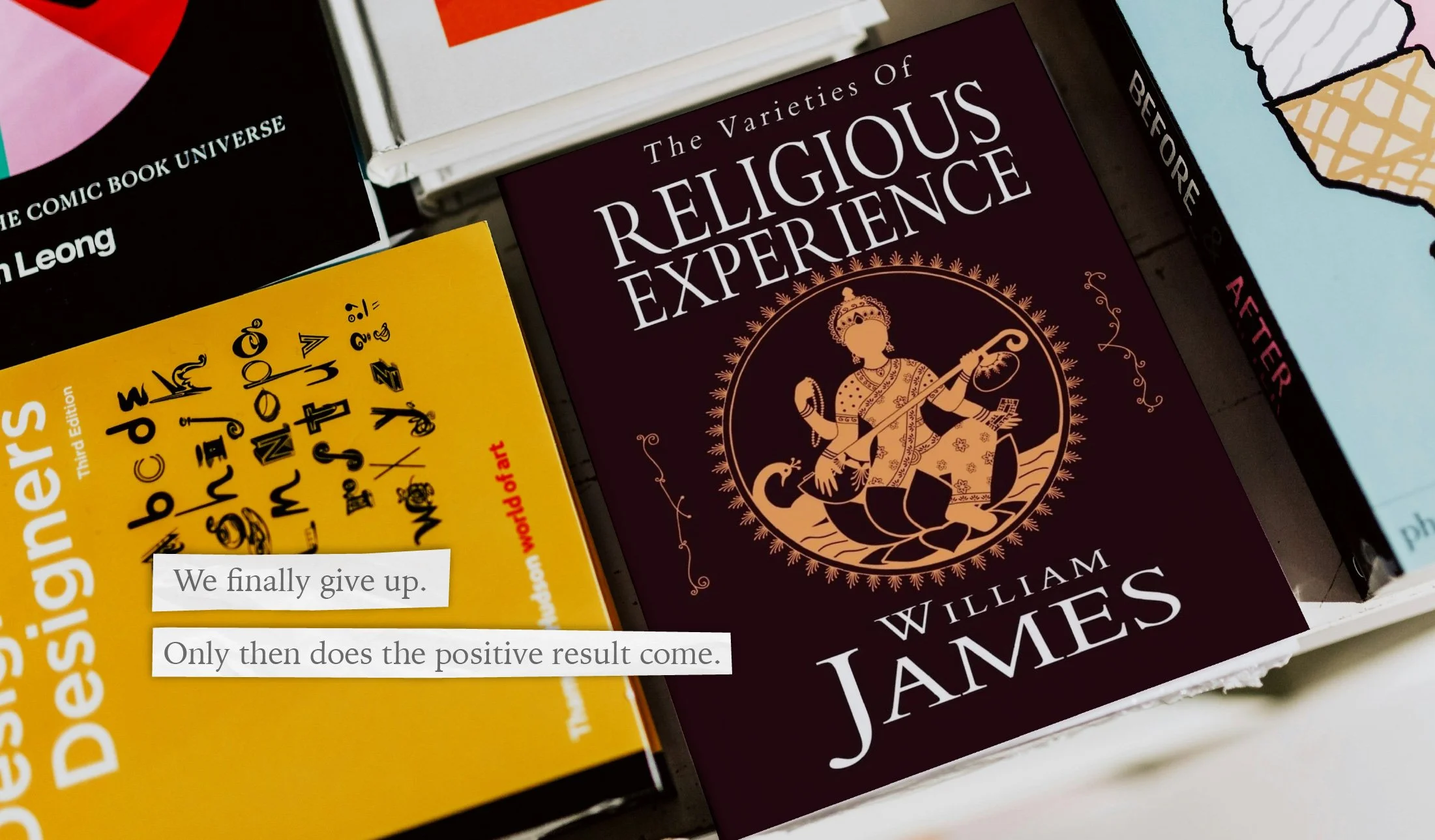
The Varieties of Religious Experience by William James with the quote “We finally give up. Only then does the positive result come.”
It might seem easy, but it’s not because it takes little effort. Instead, it’s because someone with strong faith makes it feel effortless. The easy path is not for the lazy. You’ve probably noticed how much easier it is to do something you really want to do compared to what you think you should do. Faith is like desire, and when you want something, you’re motivated to work for it. Faith just makes you want to practice, and it makes the practice enjoyable. When you have faith, practicing the Dharma is easy because there’s nothing else you would rather be doing.
For example, think about a person who loves music. They practice regularly for hours every week because they love making music. Or the person who loves to cook. They spend time shopping and preparing meals because they love to provide good food for family and friends.
For us, we need to learn to love the Buddha, Dharma, and Sangha. Only then will the path become easy and enjoyable. How do we develop this love of faith? Dharma practice requires some faith, for if we had no faith, we wouldn’t practice at all. Our effort results in a positive effect, and the positive effect strengthens our faith. This positive effect motivates us to continue our effort, resulting in more positive effect, which continues to strengthen our faith further. Our faith grows as we practice. It grows with experience. We enter the “easy path” only after treading the “hard path” for some time. The easy path may be considered the advanced path.
This all makes it sound like we should easily be able to gain the necessary faith and find ourselves on the easy path. But life is not that easy. For many, our spiritual journey doesn’t follow a neat, straight path. It often feels more chaotic and challenging. Our “path” (if we can call it that) is winding and sometimes leads us into thick jungles where the path disappears or is blocked by obstacles like fallen trees and piles of rubble, with holes that are easy to fall into. We try our best, but nothing changes. We try even harder, and still nothing happens. At least, that’s how it feels. But really, something is happening, just not in our conscious, willing minds.
In his book The Varieties of Religious Experience, William James compares this phenomenon with another experience with which we’re all familiar: that of being unable to remember a person’s name. As hard as we try, the elusive name just won’t come to mind. It’s only when we’ve given up the effort to remember, when we’re doing something else, thinking of something completely different, or of nothing at all, that the name comes to us. James thinks that a similar process can occur in spiritual life. We practice, and put forth effort repeatedly, but with no positive effect. We finally give up. Only then does the positive result come.
“To reach the next stage – knowing and seeing things as they are, the stage of irreversibility- we have to let go of the self, let of of self-willing, and allow the path to unfold before us” [2]
[1] Ratnaguna & Sraddhapa. Great Faith Great Wisdom. (Cambridge, UK: Windhorse Publications., 2016) P. 115.
[2] Ratnaguna & Sraddhapa. Great Faith Great Wisdom. (Cambridge, UK: Windhorse Publications., 2016) P. 117.