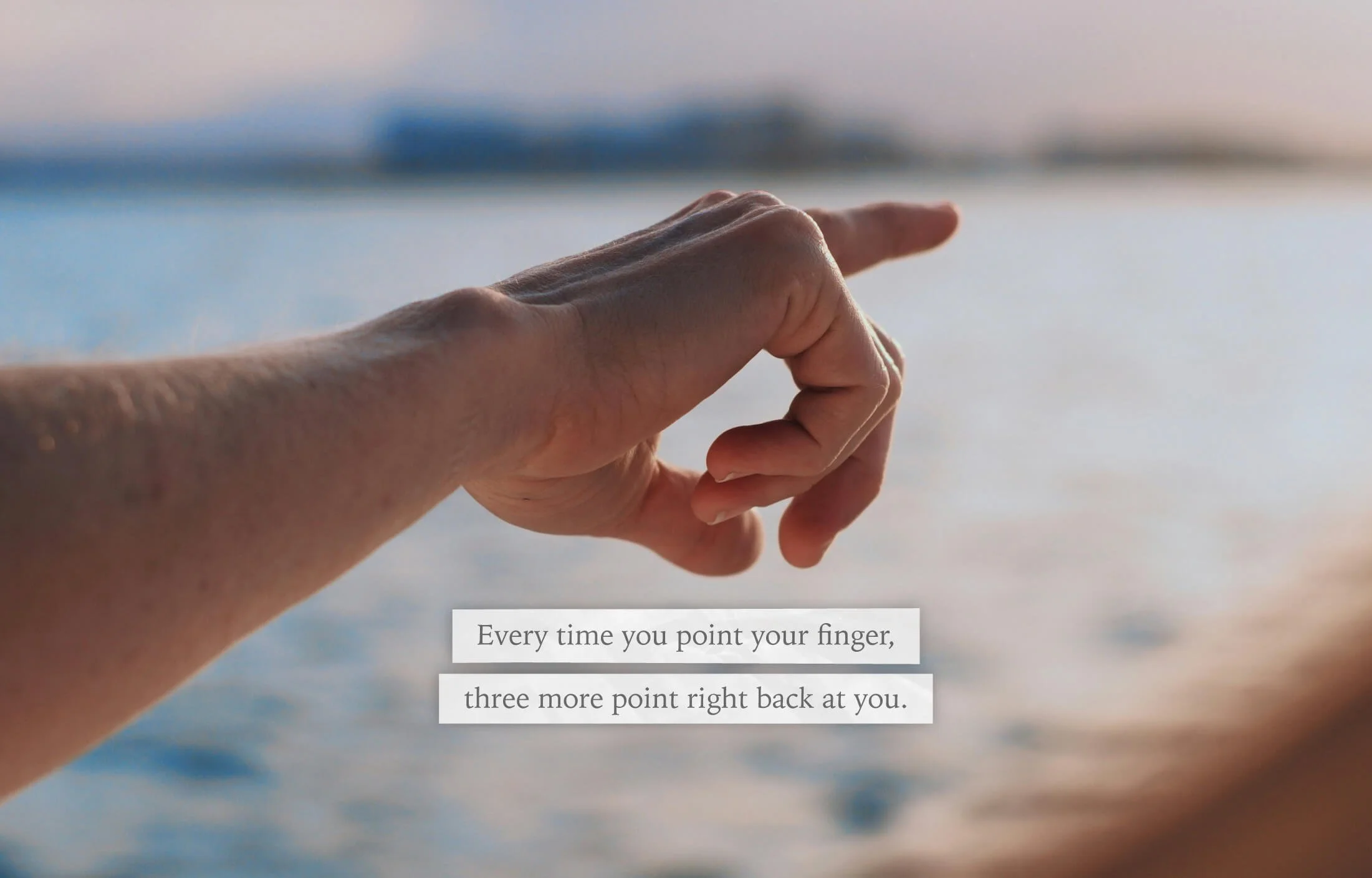
A pointed finger with text, “Every time you point your finger, three more point right back at you.”
“Every time you point your finger, three more point right back at you.” —The Goo Goo Dolls, Amigone
Before we jump in, I invite you to try this right now. Make a fist and point your index finger at something — your screen, the wall, whatever’s in front of you. Notice what your other three fingers are doing. They’re curled back, pointing at you. It’s such a simple image, but it points out a hard truth we might like to avoid: the things that bother us the most in other people are often the things we’re carrying ourselves.
I was in high school when the song Amigone came out, and the timing couldn’t have been better. Teenage angst is real! The intense emotional ups and downs and moodiness. High school was like a social minefield — who’s mad at who, who said what, who got left out of what. I was neck-deep in all of it. And it was so much easier to be the one who was wronged. When a friend was cold to me. When I wasn’t invited to a party. That nasty rumor someone spread. In those moments, blame felt like armor. If it was someone else’s fault, I didn’t have to look at my own part in it…and almost always I did have a part.
I remember one moment in particular when my friend canceled plans, again. She was always doing this! So unreliable and flaky! Days later, I caught myself doing the exact same thing — giving some last-minute lame excuse as to why I couldn’t hang out. I had to face the uncomfortable truth that I was doing the very thing that upset me so much to someone else.
In Buddhism, blaming others is seen as a fruitless reaction rooted in ignorance, anger, and the ego. My ego definitely played a role. I had built a self that I liked — sweet, kind, a good friend to all — and then was shocked when my actions didn’t match it. The truth is, most of us are carrying the same mix of wisdom and confusion, kindness and self-interest. None of us are as far above the people we criticize as we’d like to believe.
We don’t need to beat ourselves up for this either — that’s just as bad as turning the blame outward. But we can look at the situation honestly. When we catch ourselves pointing a finger, that’s actually helpful insight. What is it about this person’s behavior that’s rubbing me the wrong way? Am I doing the same thing? This inner dialogue gives us space to learn and understand ourselves better. We can’t grow past a flaw we’ve pinned entirely on somebody else.
So the next time you feel that finger start to rise — at a partner, a stranger in traffic, the news — try glancing down at your hand first. Three fingers, quietly pointing back.