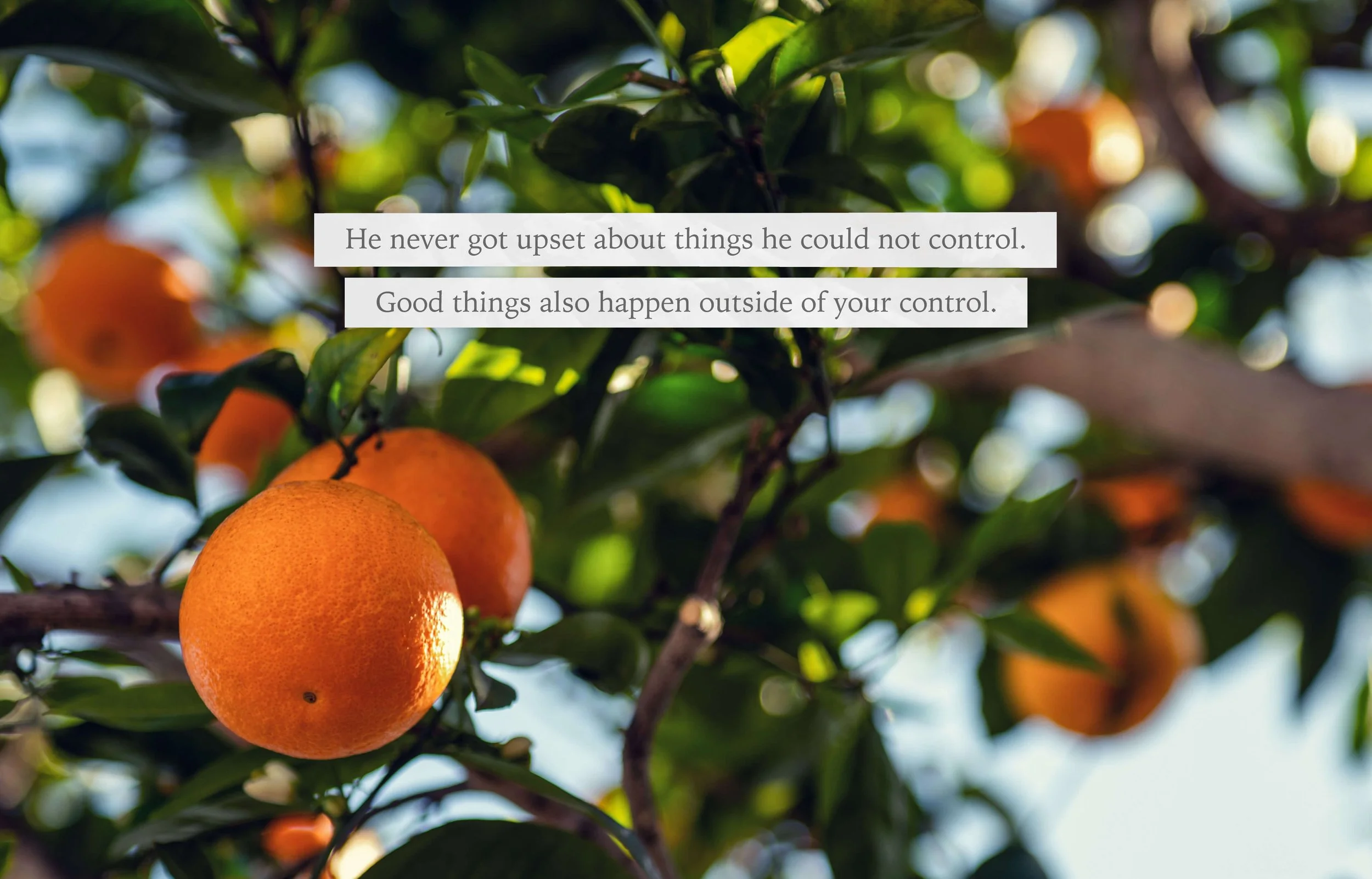
An orange grove with the text, “He never got upset about things he could not control. Good things also happen outside of your control.”
Everyone called my grandfather “Ed,” but as I got older, I noticed that his mail was addressed to J. E. Harrison. I wondered who that was. I learned that it stood for John Edward Harrison, which meant that I was named after my grandfather. My parents were very wise in making this choice. It is an honor to carry his name.
The story of his life, I am sure, is one of fact and fable. This happens naturally when studying the biography of a great man. To this day, I am still not sure which elements are which, but they equally capture the essence of the man.
He was born in 1899 in Kansas, along with his eight brothers. One story was that he sat on a cow and twisted its tail until it bucked him off. One of the hooves broke his nose. He had a dark complexion and a nose that healed in a way that gave him a strong, thin nose with a rounded profile. From the side, he looked Cherokee.
Someone also shot a pistol near his left ear, leaving him deaf in that ear. At the time, I didn’t realize why he always had me sit to his right. It was so he could hear me. My grandmother did not appreciate this as much as I did. She always got the left side when I was there.
My grandfather moved to Lindsay, California, after being in the military during World War I. Luckily, he never made it out of Kansas during the war. He came to California to be a farmer. He purchased an 80-acre orange grove right off the John Muir Trail. He worked from dawn to dusk, taking a long break for lunch during the hot midday sun. He took his work very seriously. He referred to farmers who talked more about farming than actually farming as “all hat and no cow.”
My grandmother made sure we all ate all the orange slices on our plates whenever we ate at restaurants. This was to keep the demand up for oranges.
He also had an amazing way with animals. One night, a horse got loose. His neighbors were able to corral her inside a ring of cars, all facing toward the middle with their lights on, shining on this frightened horse. But they were at an impasse. So, they went to get “Ed.”
He could talk to horses.
When he arrived, he gently walked to the middle of the circle and began to talk to this very frightened and aggressive horse. Over time, he won her over, starting with a single hand stroking her back. Then he placed a saddle on her back and a bridle in her mouth and gradually led her home on foot.
He also did what needed to be done.
One night, I heard a loud boom after midnight. I found out later that a rabid dog had made it onto the ranch, as we sometimes called it. He had to get up at 2:00 in the morning, get dressed, get his shotgun, put the dog down, and then give it a burial, all alone at night.
This is what compassion looks like when living on a farm.
No words were ever spoken of this, but in the silence came great respect for this poor dog.
Another story that is more personal for me is the time my grandfather was pushing me around the farm in an old wooden wheelbarrow. It was so old that the wood had turned gray, and the front wheel was made of steel. This was work time, so he had his leather gloves on.
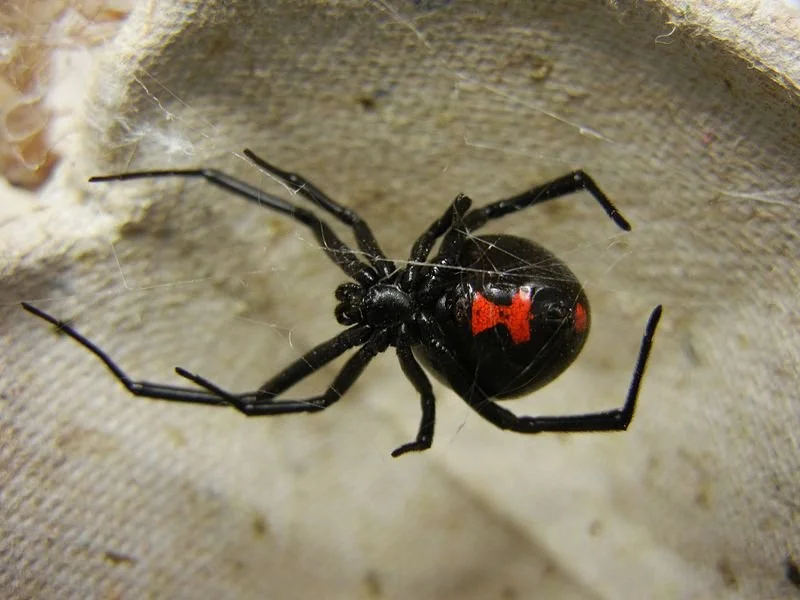
Then, right next to me, I saw a black widow spider. I could see the red hourglass on her belly.
My grandfather immediately let go of the wheelbarrow, and it tilted to one side, throwing me halfway out of the cart. I was upside down, holding myself in place with a partial handstand. Out of the corner of my eye, I could see my grandfather move to protect me, but instead, he gently picked up the spider and talked to her gently, even naming her.
He then walked over to a large oak tree and gently set her down on one of the limbs. He lifted the wheelbarrow back up, and we were on our way.
No words were spoken between us.
He was not a hero. He just did what needed to be done. Not saving me, but saving that poor, small, frightened black widow.
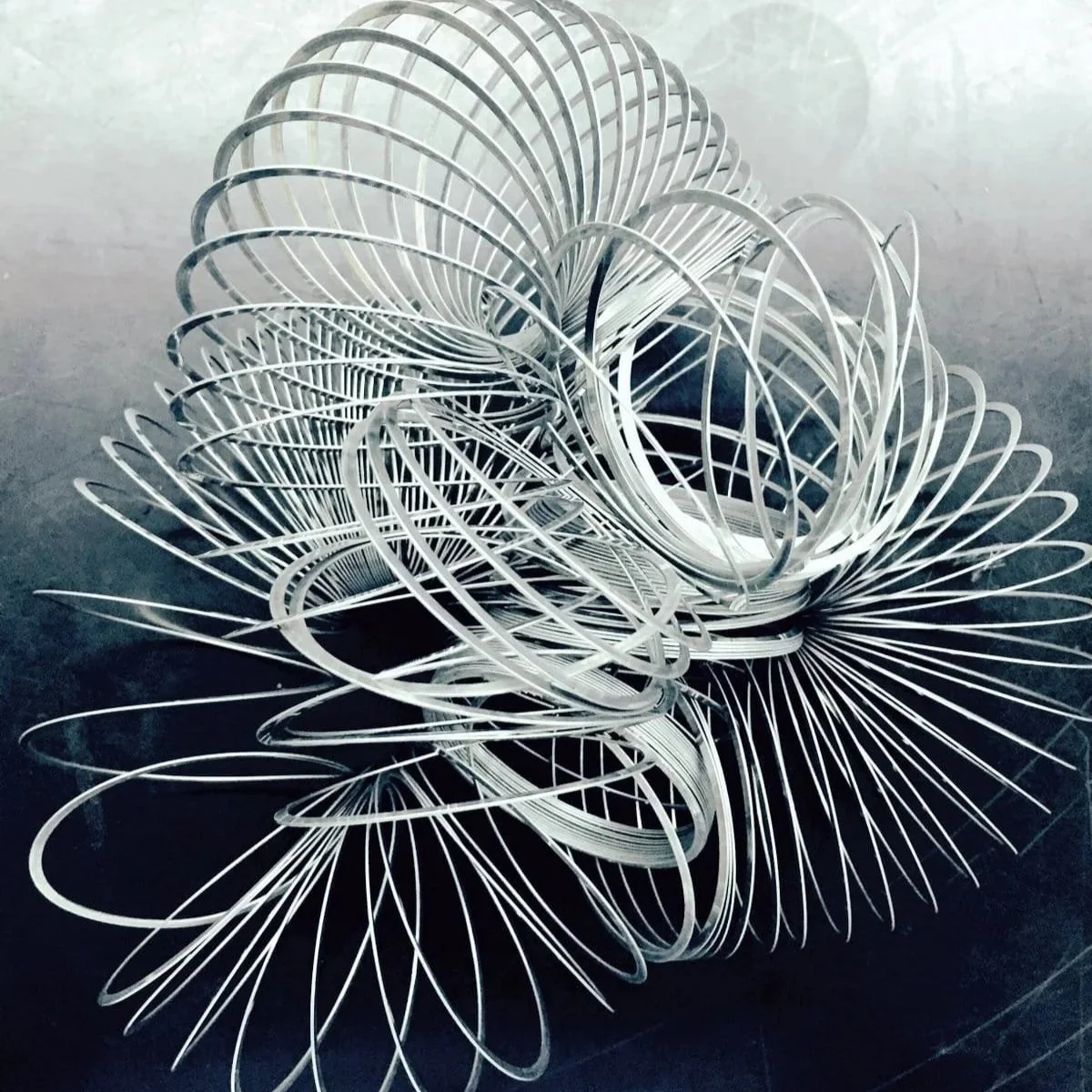
He was also incredibly patient. When I was eight, I loved to play with my Slinky. But I also got it all tangled up. He would always calmly untangle it for me, something I could never do. It took 30 minutes to untangle, almost like solving a Rubik’s Cube. But then I would have it tangled up again within five minutes, and he was never frustrated with me. He would just untangle it.
His love and care for animals also extended to people. He would never get frustrated with people or get into an argument. He would never lose his temper. He would never be triggered.
This patience also informed his farming.
One year, the water pump went out, and if it was not fixed quickly, he could lose his entire crop. My grandmother was panicking, and yet he stayed calm. He never got upset about things he could not control. The repairs were made in time, and the crop was saved.
It also went the other way. Good things also happen outside of your control.
One year, right before having the pickers come in, there was a large rainstorm. The groves were so wet and muddy that the trucks could not come into the grove to harvest the oranges. But my grandfather went for a walk and noticed that his field wasn’t that wet.
His was the only grove that could be harvested.
He was able to corner the market that year and made more money than in the past ten years combined. His retirement was now set.
In 1970, he passed away at 71 years old. I was only ten years old at the time, and it was the first funeral I had ever attended.
My grandfather had a huge impact on my life. In hindsight, I think he showed me how to live a spiritual life—one of mindfulness and compassion. These stories informed how I see and interact with the world.
He was my first sensei.
Namoamidabutsu, Jon Turner Sensei