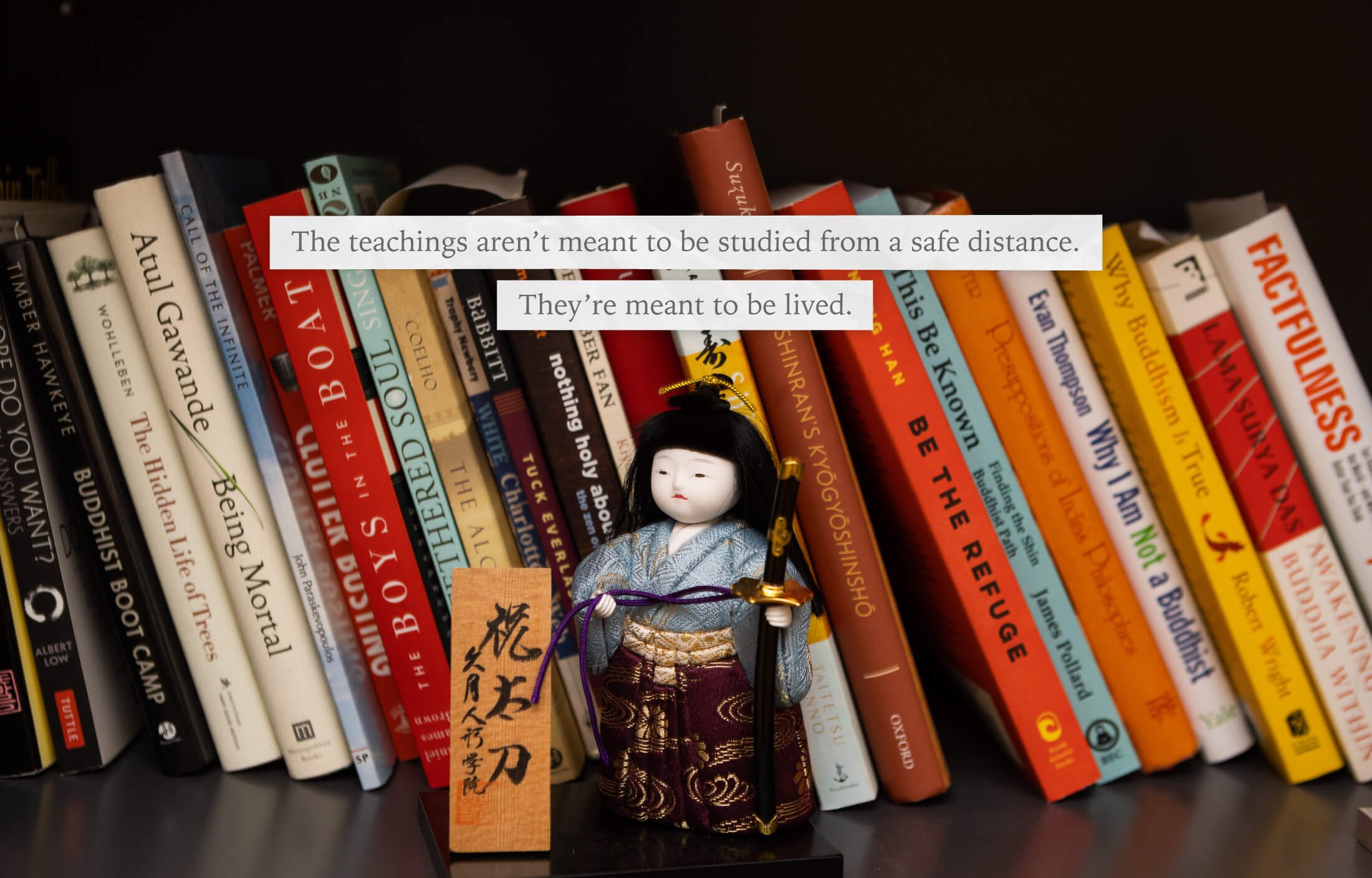
A book shelf with the text, “The teachings aren’t meant to be studied from a safe distance. They’re meant to be lived.”
If you're new to Buddhism, or even a few years into it, chances are you've stumbled into at least one of these. I certainly have — especially #4. These aren't failures, though. They're just part of how anyone learns something new. Below are a few things to look out for on your journey, but don't judge yourself or your practice as you go.
Pitfall #1: Mapping it onto Christianity
If you grew up in a Christian culture — even a loosely religious or totally secular one — your brain has a template for what "religion" looks like. It's tempting to slot Buddhism right into it. But the Pure Land isn't Heaven. Karma isn't divine punishment. And faith means entrusting, not blindly following a doctrine. These aren't small translation issues. They're different maps, pointing at different territory.
Even coming from a different branch of Buddhism, I found myself looking for the Buddhism I knew. This concept matching and comparison delayed my understanding. The good news is there is a fix. It’s not complicated but it does take patience.
Try to meet each idea on its own terms before reaching for the nearest equivalent. You'll understand it a lot faster than you'd expect this way.
👉 Learn more: 00. The Journey Begins!
Pitfall #2: Collecting knowledge instead of practicing
It's entirely possible to become an expert on Buddhism without ever being Buddhist. You can read every book, memorize the Eightfold Path, quote the sutras, and still not have practiced a single moment of it. Just like you can learn everything about baseball without ever having to swing a bat.
But here’s the thing you might not know…practice changes you in a way that reading about practice never will. Knowing the words for compassion isn't the same as being interrupted, annoyed, and choosing patience anyway. The teachings aren't meant to be studied from a safe distance. They're meant to be lived. Get in there and play the game!
👉 Learn more: 24. Understanding | Experience Buddhism With Your Practice At Home
Pitfall #3: Treating yourself as a project
Buddhism isn't a self-improvement hack. You’re not a project to optimize. It's easy to bring a Western, results-driven mindset to Buddhism, and treat awakening like a milestone to hit. But there is a paradox at the center of the practice: aiming at the outcome is often exactly what blocks it.
Sit with a thought instead of chasing it away or trying to think your way past it, and something happens that willpower alone never manages. You're not the optimizer here — you're the one being worked on. So let go of the grip, a little at a time, for a long time. And don't be surprised if you only notice the change looking backward, after you stopped reaching for it.
👉 Learn more: 34. Living | A Process Driven Life
Pitfall #4: Mixing and matching without knowing it
A Zen koan here, a Tibetan visualization there, a technique borrowed from a Theravada retreat — stacked together without really knowing where each one comes from. Combining isn't forbidden, but these traditions sometimes hold genuinely different, even contradictory views of the path. Doing it unknowingly can leave you with a practice that's quietly working against itself.
If you're just starting out, it helps enormously to start with one tradition, get your footing, and understand what you're doing before you branch out. Go deep before you go wide with the teachings.
👉 Learn more: 07. Origins | The Trail to Pure Land Teachings
Pitfall #5: Expecting a finish line
I've been practicing Buddhism for a long time, and I can tell you: there's no level-up screen. No moment where a voice says, "congratulations, you've arrived.” Most days, you won't even know if you're making progress. And then, out of nowhere, in the middle of an ordinary Tuesday, you'll notice it. You're a little more at ease. You paused half a second longer before responding. You answered someone more kindly than you would have last year. That's it. That's the whole announcement.
I find I return to the same insights again and again — impermanence, compassion, gratitude for what's been received. Each time, I understand them a little differently, a little deeper. But it's not that I'm building up understanding, stacking it brick by brick. It's more that the same truth keeps arriving, in a new way each time, and I'm gradually worn open to it. Not achieving. Receiving.
That's the practice — the returning and letting it change you. Progress here doesn't announce itself. It comes quietly. But it comes deeply.
👉 Learn more: 31. Living | The “How” and “Why” of Buddhism
Conclusion:
None of these pitfalls mean you're doing it wrong. They mean you're doing it — actually showing up, trying to understand something unfamiliar. Stumble into all five if that's how it goes. That's not a bad start. That's just a start.
We're curious: which one did you recognize yourself in?