All Things Are Made to Be So

Person in a green house with a watering can. There is a text overlays that say “we can plant seeds and pull weed but we cannot force a flower to bloom.
January is an important month for Shin Buddhists to remember our founder Shinran (1173-1263). I would like to reflect on the essence of his teaching. Among many important concepts, one phrase stands out: “Jinen-hōni” (自然法爾), meaning “all things are made to be so of themselves.” Shinran was eighty-eight years old when he expressed this realization of ultimate truth. (CWS I, pp. 427–428) . Let me explain the meaning of each character.
“Ji (自)” means “of itself”—not through our calculation.
“Nen (然)” means “to be made so,” signifying the working of the Tathagata’s Vow.
“Hōni (法爾)” refers to being made so through the working of Amida’s heart and mind to spiritually liberate all beings.
In everyday Japanese, the word 自然 (shizen) means “nature.” We think of mountains, rivers, trees, flowers—the beautiful world around us. But Shinran used the same characters differently, reading them as jinen. Jinen does not mean “nature” in the usual sense, but rather, “things as they become of themselves.” For Shinran, this expresses the spontaneous working of Amida Buddha’s great compassion. Liberation and awakening do not occur through our effort or calculation—they arise because the Dharma is already at work, guiding us, without our control.
A simple metaphor helps illustrate this. Imagine a garden. We can plant seeds and pull weeds, but we cannot force a flower to bloom. Blooming happens naturally—when sunlight, water, and soil come together. That is shizen, the natural process of growth. Yet, when we look deeper, we realize: the seed does not choose to bloom, nor do we make it bloom by will. It blooms jinen—of itself—through a greater working beyond our control. Likewise, our spiritual awakening unfolds through Amida’s Vow, embracing us just as we are.
Jinen-hōni and “Bits of Rubble Turn into Gold”:
The expression “Bits of Rubble Turn into Gold” appears in Shinran Shōnin’s Essentials of Faith Alone (Yuishinshōmoni, CWS I, pp. 459–469):
“Bits of rubble change into gold” - This is a metaphor. When we entrust ourselves to the Tathagata’s Primal Vow, we, who are like bits of tile and pebbles, are turned into gold—grasped and never abandoned by the Tathagata’s Light. Know that this comes about solely through true shinjin. We speak of the light that grasps because we are taken into the heart of the Buddha of Unhindered Light; thus, shinjin is said to be diamondlike.”
Shinran drew this metaphor from the Chinese master Hui-jih. He realized that true spiritual liberation arises through genuine entrusting (shinjin) in the working of the true and real. It is not achieved by self-effort or willpower but through the transformation that occurs when we abandon self-will and are embraced by Amida’s working. Through this transformation, we are freed from the bondage of samsaric life. Even while living with human afflictions, we are simultaneously illuminated by the unobstructed light that grasps us.
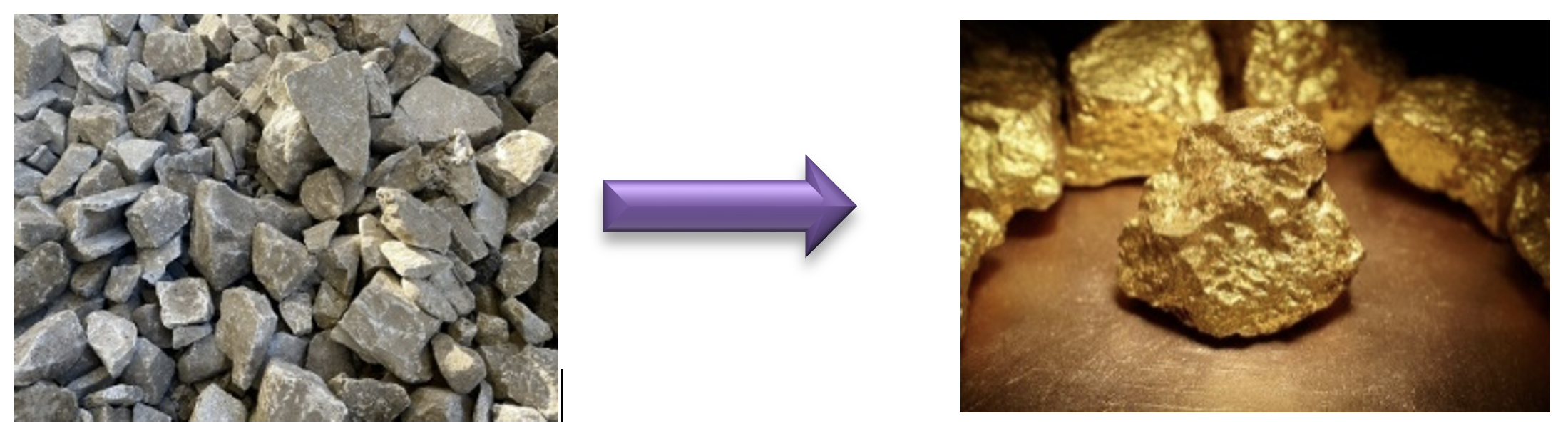
On the left, there is a pile of rough, dull gray stones. In the center, a large purple arrow points to the right. On the right, several bright, golden nuggets sit on a warm, glowing surface.
Rev. Dr. Taitetsu Unno beautifully explains this phrase:
“Foolish beings are the primary concern of Amida, and it is upon them that the flooding light of boundless compassion shines, eventually bringing about a radical transformation in life—from hopeless to hopeful, darkness to light, ignorance to enlightenment, bits of rubble to gold.” (Shin Buddhism, 2002, p.15)
This, indeed, is the experience of Shin Buddhists.
As We Hear the Nembutsu:
When we hear the Nembutsu—“Namo Amida Butsu”—let us remember:
Shizen reminds us to appreciate the natural beauty of the world around us.
Jinen reminds us to entrust ourselves to the compassionate working that carries us, like the seed that blooms of itself.
Nothing is a hindrance to our spiritual transformation.
I wish all of you good health, happiness, and a joyful year ahead under the Light of Wisdom.
Gassho,
Namo Amida Butsu