Alice in Buddhaland
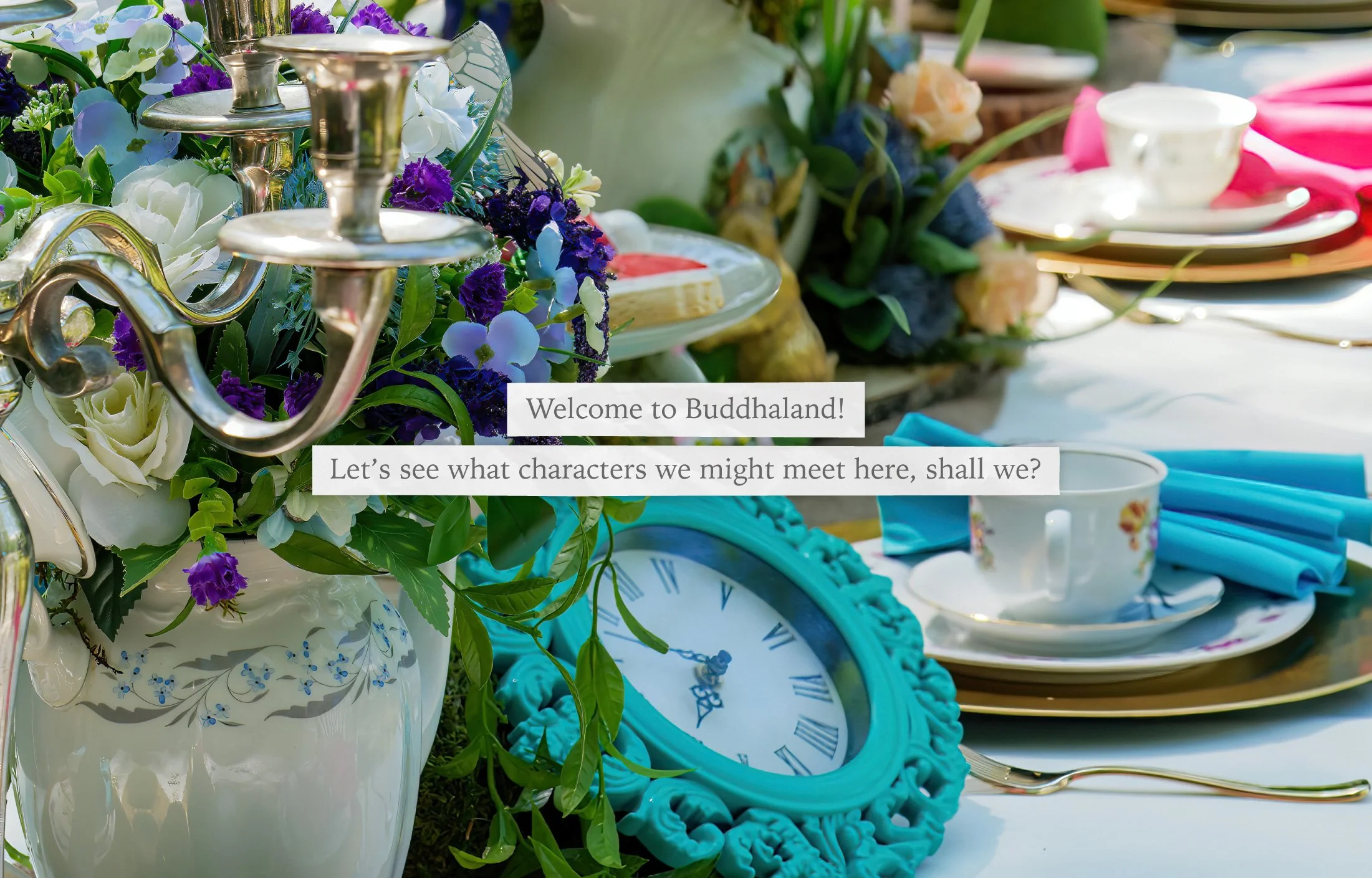
A tea party with text "Welcome to Buddhaland! Let’s see what characters we might meet here, shall we?”
"I could tell you my adventures – beginning from this morning…but it's no use going back to yesterday, because I was a different person then." – Lewis Carroll, Alice's Adventures in Wonderland
Alice in Wonderland is hands down one of my favorite books and movies. My bookshelf at home has multiple copies in different languages and versions. Most people discount it as a children's story or drug-fueled nonsense, but there's much more to it. Alice is more like us than we think. Her story is actually quite Buddhist. Throughout her adventure, she learns valuable life lessons and is challenged to view the world differently, much in the same way the Buddhist path does. So today, I invite you to go on a little adventure with me as we explore the Buddhist lessons in Alice in Wonderland.
It may have been years since you've watched or read Alice in Wonderland, so let's start at the beginning of the story. Alice is sitting on the riverbank with her sister, listening to her read a book. Alice is very bored, as the book has no pictures. All of a sudden, she sees a white rabbit with a pocket watch and a waistcoat go zipping by. "How curious!" Alice declares, and follows the white rabbit, tumbling her way down a rabbit hole and landing in Wonderland, where nothing is as it seems. Everything is nonsense and the inhabitants are all crazy! They're as mad as the Mad Hatter!
Logic and reason don't work in Wonderland. Looking at our own world, can we say logic and reason work here? To cope with the real world, we spend time visualizing patterns, finding reasons, generating explanations and theories to answer "why." But we know many of the models we use don't work. The reality is that change is certain, and change often jumps and lurches in defiance of our best-guess algorithms. We don't always understand things better, and there are some things we don't understand at all. We spend a great deal of time trying to apply logic and reason to the Buddhist teachings, much like Alice tries to use logic in Wonderland. It didn't help Alice on her journey, and it won't help ours. We will be forever chasing the white rabbit. But there's hope!
When we arrive at the Buddhist teachings, we're asked to set aside what we know and look through a different lens. Buddhism, by its very nature, asks us to see things differently. Through the sutras, we're invited to view our world through the eyes of a Buddha. It's like stepping through the looking glass into a new, enlightened world. Welcome to Buddhaland! Let's see what characters we might meet here, shall we?
Let's imagine we meet a Buddhist caterpillar sitting beneath a tree. We present the caterpillar with a little conundrum, the way Alice asks the Cheshire Cat which way to go. We tell the caterpillar we find life has this uneasy feeling about it. There are challenges and dissatisfactions we can't seem to escape. Something is off, but we can't quite put our finger on it. In fact, this feeling of samsara might be what drew us to Buddhism in the first place. The Buddhist caterpillar explains that it's how we perceive reality that causes the uneasy feeling — being caught in the delusions of the senses and the judgments of the ego is at the root of it. But not to worry, he says. Insight is the solution. Insight will make the uneasy feeling stop. From there, he outlines a path to take: walk this Buddhist path every day, and you'll gain insight. In other words, we'll find the white rabbit we're chasing after — awakening itself.
In the story, Alice catches up to the white rabbit at the Queen's croquet party. The Queen invites Alice to play, and it doesn't go well. Before we know it, Alice finds herself in court, and it's the most backwards trial there is — literally, they start with the verdict before the evidence. As the trial unfolds and chaos swirls around her, Alice realizes something. Perhaps a moment of awakening? Alice sees that the whole of Wonderland is filled with illusions, egos, and everyone playing the part of the Mad Hatter. As she sees through this false reality, she realizes she doesn't have to be imprisoned by a deck of cards or sit through this sham trial. Insight gives her the option to run away, and she does.
In the next scene, Alice awakens beside the riverbank where she and her sister were sitting. Alice woke up! Perhaps we could say she awakened the way the Buddha might have. Wide awake, she sits and digests this deep new insight. She has learned to see herself in a new, more truthful way, and her lens on the world has changed.
The Buddha gave us teachings meant to help us see things differently. Our world is a world of illusions and nonsense, much of it driven by our egos. We do our best to apply logic and reason to things, to create understanding, but it doesn't work. We still have that uneasy feeling. Are we imprisoned by something we don't actually have to be? Or can we kick down the deck of cards, like Alice?
As we journey through this life on the Buddhist path, we can have moments where we see things clearly — where we kick down the cards. We can see our faults and our foolish nature. We can embrace our true selves, which is what Alice does in her adventure. Her curiosity leads her on a journey of self-discovery, much like our Buddhist practice does. By the end of the story, Alice has become a completely different person. By the end of our journey, we're completely transformed too. We see things through a different lens. We may not be Buddhas, but we're not the same as when we started.
In the words of Alice…
"I could tell you my adventures – beginning from this morning…but it's no use going back to yesterday, because I was a different person then."
Each day we walk the Buddhist path, we are changing and evolving. We are setting aside our old views and adopting new ones. These new views give us a different way to see and experience the world — and ourselves.